


Chronological listing with reign, title and posthumous title(s), where known.
* 802-850: Jayavarman II (Paramesvara)
* 854-877: Jayavarman III (Vishnuloka)
* 877-889: Indravarman II (Isvaraloka)
* 889-910: Yasovarman I (Paramasivaloka)
* 910-923: Hashavarman I (Rudraloka)
* 923-928: Isanavarman II (Paramarudraloka)
* 928-941: Jayavarman IV (Paramasivapada)
* 941-944: Harshavarman II (Vrahmaloka or Brahmaloka)
* 944-968: Rajendravarman (Sivaloka)
* 968-1001: Jayavarman V (Paramasivaloka)
* 1001-1002?: Udayadityavarman I
* 1002-1011?: Jayaviravarman
* 1001-1050: Suryavarman I (Narvanapala la)
* 1050-1066: Udayadityavarman II
* 1066-1080?: Harshavarman III (Sadasivapada)
* 1080-1113?: Jayavarman VI (Paramakaivalyapada)
* 1113-1150: Suryavarman I (Paramavishnuloka)
* 1150-1160: Dharanindravarman II (Paramanishkalapada)
* 1160-1165/6: Yasovarman II
* 1181-1220?: Jayavarman VII (Mahaparamasangata?)
* 1220-1243: Indravarman III?
* 1243-1295: Jayavarman VIII (abdicated) (Paramesvarapada)
* 1295-1308: Indravarman III?
* 1300-1307?: Srindravarman (abdicated)
* 1308-1327: Indrajayavarman
* 1330-1353: Paramathakemaraja
* 1371-?: Hou-eul-na
* 1404: Samtac Pra Phaya
* 1405: Samtac Chao Phaya Phing-ya
* 1405-1409: Nippean-bat
* 1409-1416: Lampong or Lampang Paramaja
* 1416-1425: Sorijovong, Sorijong or Lambang
* 1425-1429: Barom Racha, or Gamkhat Ramadhapati
* 1429-1431: Thommo-Soccorach or Dharmasoka
* 1432-?: Pnha Yat or Gam Yat
Showing posts with label Empire. Show all posts
Showing posts with label Empire. Show all posts
Friday, April 1, 2011

Khmer Empire
The Khmer Empire was a powerful kingdom based in what is now Cambodia. At times, it ruled over and/or vassalised parts of modern-day Laos, Thailand and Vietnam. The empire's greatest physical legacy is Angkor, which was its capital. Angkor bears testimony to the Khmer Empire's immense power and wealth, as well as the variety of belief systems that it patronised over time. The empire's official religions included Hinduism, Mahayana and Theravada Buddhism.
Sunday, September 20, 2009
Khmer Empire
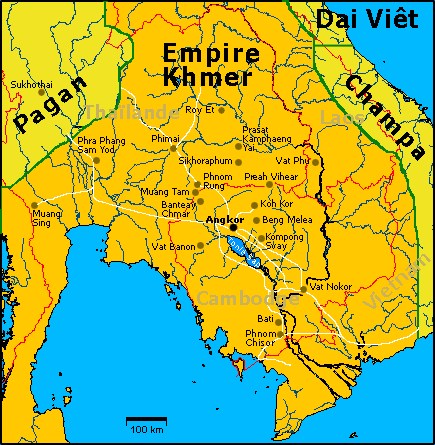
The Khmer Empire was the third largest empire of South East Asia (after Srivijaya and Majapahit), based in what is now Cambodia. The empire, which seceded from the kingdom of Chenla, at times ruled over and/or vassalised parts of modern-day Laos, Thailand, Vietnam, Myanmar, and Malaysia. During the formation of the empire, Khmer had close cultural, political and trade relations with Java, and later with Srivijaya empire that lay beyond Khmer's southern border. Its greatest legacy is Angkor, which was the capital during the empire's zenith. Angkor bears testimony to the Khmer empire's immense power and wealth, as well as the variety of belief systems that it patronised over time. The empire's official religions included Hinduism and Mahayana Buddhism, until Theravada Buddhism prevailed after its introduction from Sri Lanka in the 13th century. Modern satellites have revealed Angkor to be the largest pre-industrial urban center in the world, larger than modern day New York.
The history of Angkor as the central area of settlement of the historical kingdom of Kambuja is also the history of the Khmer from the 9th to the 15th centuries.
From Kambuja itself - and so also from the Angkor region - no written records have survived other than stone inscriptions. Therefore the current knowledge of the historical Khmer civilization is derived primarily from:
* archaeological excavation, reconstruction and investigation
* inscriptions on stela and on stones in the temples, which report on the political and religious deeds of the kings
* reliefs in a series of temple walls with depictions of military marches, life in the palace, market scenes and also the everyday lives of the population
* reports and chronicles of Chinese diplomats, traders and travellers.
The beginning of the era of the Khmer kingdom of Angkor is conventionally dated to 802. In this year, king Jayavarman II had himself declared "Chakravartin" (king of the world).